Saturday, August 24, 2019

Day 7 (24 August 2019) in Olsztyn, Poland

Finally, just to mention something about the country; Poland is a country located in Central Europe. It has 16 administrative subdivisions, covering an area of 312,696 square kilometres (120,733 sq mi), and has a largely temperate seasonal climate. With a population of approximately 38.5 million people, Poland is the sixth most populous member state of the European Union. Poland share border with the Baltic Sea, Lithuania, and Russia's Kaliningrad Oblast to the north, Belarus and Ukraine to the east, Slovakia and the Czech Republic to the south, and Germany to the west. Poland is also one of the oldest country in the world with a history of human activity on its soil spans almost 500,000 years.
Warsaw international airport!
The establishment of the first Polish state can be traced to AD 966, when Mieszko I (ruler of the realm coextensive with the territory of present-day Poland) converted to Christianity. However, the Kingdom of Poland was established in 1025, and in 1569 it cemented its longstanding political association with the Grand Duchy of Lithuania by signing the Union of Lublin, which led the formation of Polish–Lithuanian Commonwealth and adopted Europe's first written national constitution, the Constitution of 3 May 1791. Poland regained its independence in 1918 from the Union of Lublin with the Treaty of Versailles. After a series of territorial conflicts, the new multi-ethnic Poland restored its position as a key player in European politics. In September 1939, World War II started with the invasion of Poland by Germany, followed by the Soviet Union invading Poland in accordance with the Molotov–Ribbentrop Pact. Around six million Polish citizens, including 90% of the country's Jews, perished in the war. In 1947, the Polish People's Republic was established as a satellite state under Soviet influence. In the aftermath of the Revolutions of 1989, most notably through the emergence of the Solidarity movement, Poland reestablished itself as a presidential democratic republic, which what they have today. 
Although it got its name, Poland, due to the dominance of the Western Polans in the region, the country is more diverse since the Iron age. Poland's economy is considered to be one of the more resilient of the post-Communist countries and is one of the fastest growing within the EU, with the largest Stock Exchange in the East-Central European zone and the sixth largest economy by GDP (PPP) in the European Union. Since the fall of the communist government, Poland has pursued a policy of liberalizing the economy; a transition from a centrally planned to a primarily market-based economy. The country's most successful exports include machinery, furniture, food products, clothing, shoes and cosmetics. I'm very surprised with the variety of products that country manuifactured/produced. Just to mention some of the products and goods manufactured in Poland: electronics, buses and trams (Solaris, Solbus), helicopters and planes (PZL Świdnik, PZL Mielec), trains (Pesa SA, Newag), ships (Gdańsk Shipyard, Szczecin Shipyard, Gdynia Polish Navy Shipyard), military equipment (FB "Łucznik" Radom, Bumar-Łabędy SA), medicines (Polpharma, Polfa), food (Tymbark, Hortex, E. Wedel), clothes (LLP), glass, pottery (Bolesławiec), chemical products and others. Poland is also one of the world's biggest producers of copper, silver and coal, as well as potatoes, rye, rapeseed, cabbage, apples, strawberries and ribes.
Poland has very high standards of living, life quality, safety, education, and economic freedom; also the state provides free university education, social security, and a universal health care system. Politically, Poland is one of strategic state, and is a full member state of the European Union, the Schengen Area, the United Nations, NATO, the OECD, the Three Seas Initiative, the Visegrád Group, and guested at the G20
Anyway, my trip to Poland was very successful. I'm now heading back to home. I'm at Paris international airport. 
Paris international airport!

Friday, August 23, 2019

Day 6 (23 August 2019) in Olsztyn, Poland

Today is the last day of the conference. In general, the conference went out successfully. We concluded the meeting with two presentation from the Hermanus and University of Brunswick who showed us their perspective facilities to host the next Beacon symposium will be held in 2022. Both presentation showed their best to impress the audience, showed us different possible meeting venue, hotels, tourist attraction places to see, etc.
Finally, the meeting adjourned by honoring best young scientist presentations.
Since I had free afternoon, I went for a walk with one of my former student, who came from Ethiopia for this conference. I got a chance to see the university compound, which is very beautiful. We continued walking all the way down to old town where we have dinner and took a taxi back to my hotel. Tomorrow, I'll be heading back home via Warsaw. The shuttle bus will be at my hotel at 7:54am to pick me up and drive me to Warsaw international airport which is a little over 3hrs drive.
The 2019 Beacon Symposium Young Scientist honorees 

Day 5 (22 August 2019) in Olsztyn, Poland

AS usual, today was busy day at work. However, after the conference I went out for shopping with my Bostonian colleagues. We went to Galeria Warminska mall. We're told Olsztyn is the place where you can find AMBER jewelry.
The mall
After the shopping we went to Pierogarnia Bruner restaurant to have dinner. We tried the typical local food called "Pierogi" in English it's called dumpling, stuffed with different kind, beef, chicken, cheese, spinach, lentils, etc.
Pictures from the old town city center, with local traditional cloth! 
My dinner, Roasted dumplings stuffed with chicken!

Day 4 (21 August 2019) in Olsztyn, Poland

Today is very exciting day, because we'll have excursion this afternoon. 
In the afternoon, we went out for excursion. That gives me to see Olsztyn city. Guided by professional tour guide of the city makes our tour very interesting. We started our tour at the old town that was established in the 14th century.   
The maps of old town
Acording to Wikipedia, the city was founded as Allenstein in the 14th century, Olsztyn was under the control and influence of the Teutonic Order until 1454, when it was incorporated into the Polish Crown. For centuries the city was an important centre of trade, crafts, science and administration in the Warmia region linking Warsaw with Konigsberg. Following the First Partition of Poland in 1772 Warmia was annexed by Prussia and ceased to be the property of the clergy. In the 19th century the city changed its status completely, becoming the most prominent economic hub of the southern part of Eastern Prussia. The construction of a railway and early industrialization greatly contributed to Olsztyn's significance. Following World War II, the city returned to Poland in accordance with the Potsdam Agreement. Since 1999 Olsztyn has been the capital city of the Warmia-Masuria. The population of the city was estimated at 172,362 residents in 2018.
One of the main attraction point in the city is the monumental St. James church, which is located in the heart of the Old Town. Its construction took place over decades – it had begun after the foundation of Olsztyn and was finished between the 14th and 15th centuries. Since 1965 the church is the location for the tomb of the Warmia archbishops. In 1973 the church was appointed a co-cathedral, in 1992 the arch-cathedral and in 2004 a minor basilica. The last title was granted by Pope John Paul II who conducted a service here during his pilgrimage in 1991. The Basilica is the oldest sacred building in the city and the region’s unique relic. It is open to tourists daily, except when services are held.
Engraved statue of Pop Paul II at the outside wall of the church
One of very few Basilica outside Rome! 
Inside view of the Basilica! 
Another visible site in Olsztyn is the castle. The Castle of Warmian Bishops in Olsztyn was built in the 14th-century in the Gothic architectural style. The castle had the role of being the administration headquarters for the Bishops of Warmia. The most well-known administrator was Nicolaus Copernicus between 1516 and 1521. Currently, the castle houses the Museum of the Warmian-Masurian Voivodeship. 
Outside side of view of the castle!
Inside view of the castle

Day 3 (20 August 2019) in Olsztyn, Poland

It is the second day of the conference, and I spent the whole day at the conference room. However, at the end of the conference, there was planetary show at Olsztyn planetarium.
Planetarium in Olsztyn, which is the second largest planetarium in Poland, was opened on February 19, 1973, on the 500th anniversary of the birth of Nicolaus Copernicus under the name Space Planetarium. In addition to the normal planetarium show, I've witnessed two unique thing at the Olsztyn planetarium. How many of us know how many Sputnik satellite the Russian manufactured? They built three identical Sputnik but they only put one of them in orbit. So, where are the other two? Well, one of them is now on display at the Olsztyn space planetarium. It was given to Poland by the Russian President. The other unique thing is that the three pieces of moon rock that given to Polish president by President Nixon of USA. 
BTW, this is the space planetarium show that include more detail information than any other space planetarium show that I've seen. 
One of the original Sputnik Satellite
The four pieces of moon rock!
The planetarium computing system!

Thursday, August 22, 2019

Day 2 (19 August 2019) in Olsztyn, Poland

As expected, I did not have good sleep, woke up in the middle of night. I'd to prepare and got myself ready to walk to the conference venue which is at the University ---, which is five minute walk from our hotel. The opening ceremony is a bit fancy with different dignitaries, including the mayor (the call him president) of Olsztyn and rector of the university.

This where we'll be hiding for the next one week!
The opening ceremony also include Polish cultural dance by the university's band. Other than the fancy opening ceremony, we're back to formal work.

Dancing band entertainment at the opening ceremony 
Olsztyn (OL-shtin) is a city on the Łyna River in northeastern Poland. Olsztyn is the capital of the Warmian-Masurian Voivodeship, and is a city with county rights. The population of the city was estimated at 172,362 residents in 2018. Since 1999 Olsztyn has been the capital city of the Warmia-Masuria. In the same year, the University of Warmia and Masuria was founded from the fusion of three other local universities. Today, the Castle of Warmian Bishops houses a museum and is a venue for concerts, art exhibitions, film shows and other cultural events, which make Olsztyn a popular tourist destination.
The University of Warmia and Mazury (UWM) in Olsztyn was established on 1 September 1999, on an agreement between the academic senates of three institutions of higher learning already established in the city: the Academy of Agriculture and Technology, the Pedagogical Institute, and the Warmia Institute of Theology. The Faculty of Theology was established with an agreement between Polish Episcopate (Bishop) and the government. The university's first academic year started in October 1999. 
This reminds me the university where I started my academic career as a young faculty member, The Bahir Dar University (BDU) in Ethiopia. Like UWM, BDU was also established in 1999 by merging two higher learning institutes (Polytechnic Institute and the Pedagogical Institute also known by teachers training college) already established in the city. Currently, while UWM has 16 faculties, 3035 admin staff, 43000 students, 3000 postgraduate students, and 350 PhD students, the BDU has ----. BDU world ranking is 3123 but that of UWM is 1231.
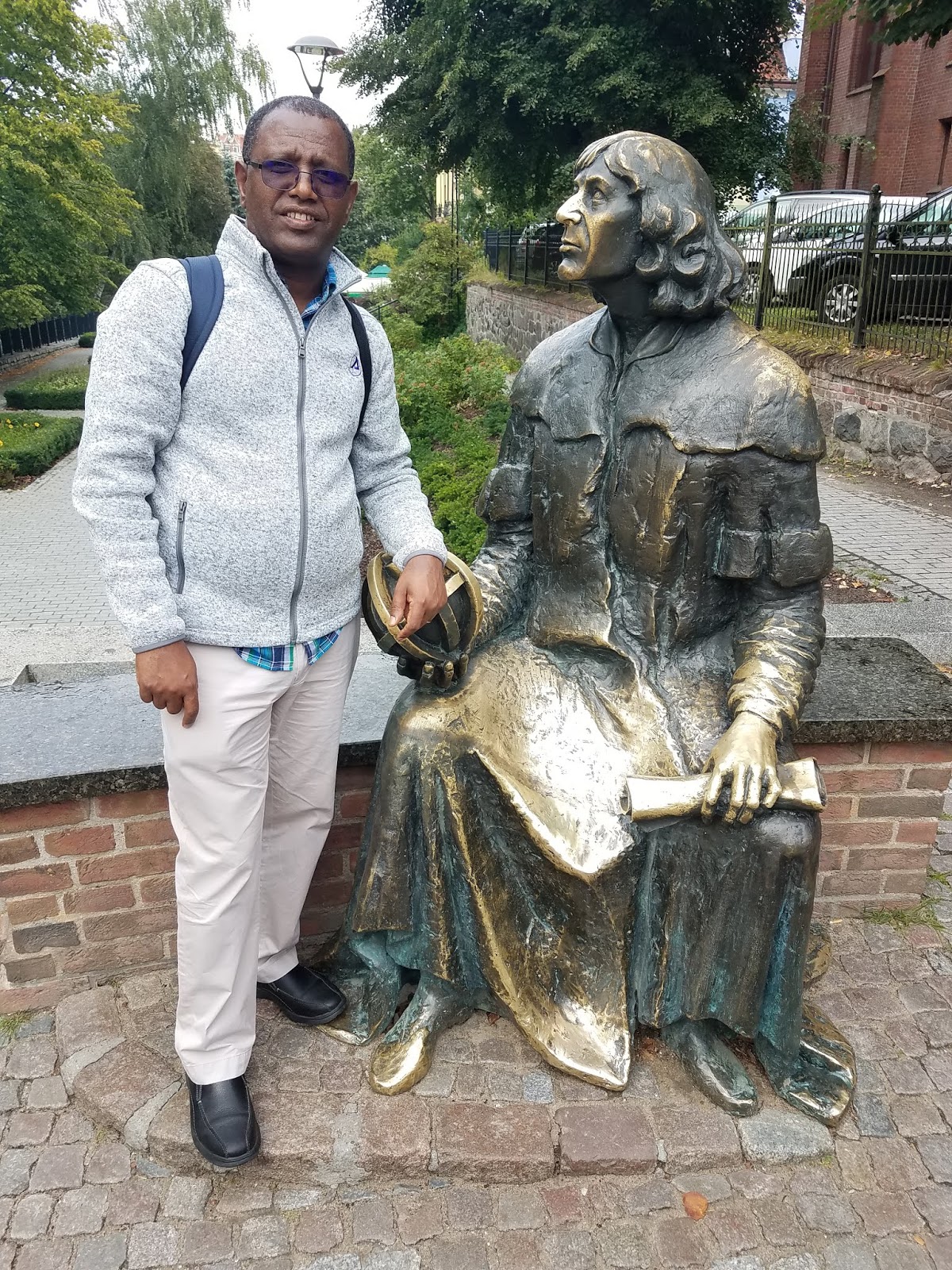
With Nicolaus Copernicus statue, located at the main gate of the castle
Another new thing that I learned at the opening ceremony was from the Mayor's opening remarks. Knowing we're space scientists from different part of the world, he pointed out the connection between his city and the famous astronomer, Nicolaus Copernicus (19 February 1473 – 24 May 1543). He said, Copernicus resided at Olsztyn (Allenstein) Castle during 1516–21, served as economic administrator of Warmia, including Olsztyn(Allenstein) and Pieniężno (Mehlsack). While there, he wrote a manuscript, Locationes mansorum desertorum (Locations of Deserted Fiefs), with a view to populating those fiefs with industrious farmers and so bolstering the economy of Warmia. When Olsztyn was besieged by the Teutonic Knights during the Polish–Teutonic War, Copernicus directed the defense of Olsztyn and Warmia by Royal Polish forces. He also represented the Polish side in the ensuing peace negotiations.  
Copernicus original book
For some reason, the heliocentric idea was demonstrated by Galileo. I was wrong, it was actually by Copernicus. Nicolaus Copernicus was a Renaissance-era mathematician and astronomer, who formulated a model of the universe that placed the Sun rather than Earth at the center of the universe, independently confirming Aristarchus of Samos's formulation that was proposed some eighteen centuries earlier.
Copernicus was born and died in Royal Prussia, which is part of the Kingdom of Poland since 1466. He obtained a doctorate in canon law (set of ordinances and regulations made by ecclesiastical authority (Church leadership). He was also a mathematician, astronomer, physician, classics scholar, translator, governor, diplomat, and economist. In 1517 he derived a quantity theory of money - a key concept in economics - and in 1519 he formulated an economic principle that later came to be called Gresham's law.
His original astronomical table
His working table and chair
His Portrait

Day 1 (18 August 2019) in Olsztyn, Poland

For some reason, I remember the word "Warsaw" when I was undergrad student at Addis Ababa University in Ethiopia. However, I could not remember why?? Anyway, here I'm, science brought me here in Poland and got a chance to see the city of Warsaw from air as well as through the windows of the train that rode from the Warsaw international airport to the Warsaw central train station.
I'll be staying in Poland for a week, attending the 2019 Beacon Satellite Symposium that will be held in Olsztyn that is located about 200km away from Warsaw to the north. I'm about to take my direct train from Warsaw central station to Olsztyn.
The Warsaw international airport looks very informative. As soon as I stepped out of the gate, everything has very clear direction. There is a marked colored lines that lead you to different ground transport (bus, taxi, and train) stations. Since I was not sure which way I should go to Olsztyn, I did ask information center which is located at the ground level. The lady speaks very good English and quickly told me that she did not have a train ticket to Olsztyn but recommended me to get the ticket by going to the central station or from the ticket machine at one floor down (where I can catch the train). I took the first recommendation and bought a ticket to central station. Although there're TV screens at the level where you can catch the train, there're staff members on your way and very keen in answering my questions. 
I arrived at central station and bought my ticket to Olsztyn, but I had to wait for about an hour to board the next train to Olsztyn. While I was waiting, I was walking around and found Subway restaurant, and I dashed in search of my lunch. I found very interesting stuff there. Have you heard/seen chili paper bread? I was curious to test as I'm a person of spacy food. It was so delicious but not that hot as I expected. 
Finally, I boarded my train to Olsztyn. It took me about 2hrs. However, it gave me clear opportunity to see the countryside of Poland, a predominantly catholic country. Of course, the late Pop John Paul is also from Poland. 
On my way to Olsztyn.
When I finally made to my hotel in Olsztyn. Later I reunion the other US contingents (from BC and MIT) whom I had dinner with. Tomorrow will be when we kick off the conference.                

Sunday, October 28, 2018

Day 8 (27 October 2018) in Ahmedabad, India

Waked up at 1:30am to catch my flight back to Boston that depart at 5:30am from Ahmedabad International airport. My colleague from MIT and I took the hotel car to airport. We boarded Etihad airline and left India on time. I’ve to say, Etihad airline service onboard was great but the service crew at the gate in Abu Dhabi Airport was very cruel if I use very soft term. Other than that my trip to India was so productive and successful. I can’t wait to be home.
Pictures taken at Abu Dhabi Airport 

Day 7 (26 October 2018) in Ahmedabad, India

The last day of the conference and last day for me to see daylight in Ahmadabad. The conference concluded successfully just a few minute earlier than scheduled. In general, the meeting went out very well. One thing that made many of us unhappy (just for fun) was spending the entire week without a single drop of alcohol into our mouth. The state where we had the meeting (Gujarati state) is a dry state, and can find no alcohol in any places or restaurants. Well! We demonstrated that scientist can survive without bear for a week long. However, we had our last dinner at the nearby (from our hotel) restaurant, which looks like western style restaurant, and there we found margaritas. Yes! Don’t be happy it is non alcoholic. Here is the orange margaritas that I had at this restaurant. BTW, the food at this restaurant was the best food most of us ever had since we arrived in Ahmadabad.
 Panel discussion at the closing ceremony
 These are top young scientist winners!
 See you in three or four years somewhere on our globe!
Orange Margaretta!

Day 6 (25 October 2018) in Ahmedabad, India

It was again busy day at work and did not see anything new today, except a few of us were taken to sovinor shopping place where you can find Indian traditional clothes and scarps as well us some suvinours. 
Fully at work
One of funny commercial!

Day 5 (24 October 2018) in Ahmedabad, India

Today is the excursion tour day. We went to see two prominent historic site in Ahmadabad. The first stop was the place where Gandhiji isolated himself when he returned back from South Africa, a country where he gained knowledge about rebellion against the European colonizer is a legitimate action and must be done. It is now called Sabarmati Ashram (also known as Gandhi Ashram, Harijan Ashram, or Satyagraha Ashram) and is located in the Sabarmati suburb of Ahmadabad, adjoining the Ashram Road, on the banks of the River Sabarmati. This was one of the residences of Mahatma Gandhi who lived there for about twelve years along with his wife Kasturba Gandhi, after he returned back from South Africa. Ashram means monastery. This was the place where he trained countless Indian followers to fight against the British colonizers. It was also served as his base when he led the Dandi march (241 miles from the ashram) also known as the Salt Satyagraha on 12 March 1930, with 78 companions in protest at the British Salt Law that increased the taxes on Indian salt in an effort to promote sales of British salt in India. In recognition of this march and its significant influence for the Indian independence, the Indian government has established the ashram as a national monument.  
Gandhi perfectly knew that unless they (the Indian) do the dirty job and librate their country, no one can do it for them. He also knew that can not come without any scarification, but he was very much prepared to pay whatever price the colonizers may tag on him. While at the ashram, he formed a tertiary school that focused on manual labour, agriculture and literacy, in order to advance the awareness of Indians so that they understand his efforts for the nation's self-sufficiency. He also wrote several articles about this in which made colonizers uncomfortable. Although his eye opener articles draw unimaginable support from the Indian and even attracted massive follower into his little monastery, it costed him several scarification to pay. He was beaten, arrested, sentenced to serve longtime in Jail though it was not as long as 28 years as Mandela did to liberate South African from the ruthless Apartheid rulers. Gandhi also knew economic pressures on the rulers was the main tools to liberate India, and educated India to do just that. The economic pressures includes boycotting foreign products, such us clothes, alcohol, salts and others. He even requested Indian to burn their foreign clothes and asked them to make their clothes from domestic cotton, though most of the cotton farms are owned by the rulers. (Every time, I visited any historical place I always found some kind of similarities. For example, the equipment the Gandhi followers were using to make their clothes at the monastery looks very much similar with the equipment that the Ethiopian still use in the countryside to make the traditional clothes.) All these mass civil disobedience that he led had of course severe consequences. For example, his Salt march led to the jailing of some 60,000 freedom fighters by the British Raj over the following three weeks and losing control of his base, ashram. Since the British rulers refused to give his base back, Gandhi later disband the ashram and make his once crowded base a deserted place but local citizens decided to preserve it. Gandhi had vowed that he would not return to the ashram until India had gained independence, and he was assassinated on 30 January 1948.
The first house in ashram where Gandhi and his family lived!
The instrument that was used to make clothes from cotton!
Protest symbolism; hear no evil, see no evil, and speak no evil!
 Leaving Ashram with full of new culture!
The next stop was Sardar Vallabhbhai Patel national memorial, which is a museum and exhibition centre dedicated to Sardar Vallabhbhai Patel (the first home minister of India after independence) at Moti Shahi Mahal, located in Shahibaug, Ahmedabad. Moti Shahi Mahal was constructed by the Mughal emperor Shahjahan between 1618 and 1622. The saloon is spacious and lofty as the building; the walls are covered with a white stucco, polished like the finest marble, and the ceiling is painted in small compartments with much taste. The angular recesses lead to eight small octagon rooms, four below and as many above with separate stairs to each. They are finished in the same style as the saloon. The flat roof commands a wide view; the rooms under the saloon, and a surrounding platform ornamented with small canals and fountains, form a cool retreat. Vallabhbhai Patel memorial is also located on the ground floor of the palace, covering the central hall and four adjacent rooms. Patel, as India's first home minister after independence, was very instrumental in integrating princely states into India and created a unified India that the world knows today. In short, he saved India from disintegration into pieces; because right after independence, many of the princely states intended to declare independence and consider themselves as sovereign countries. Patel protected such act with very matured diplomacy and even by force when the diplomacy failed. That is why he earned special respect by many Indians, probably the same respect as Mahatma Gandh, his comradeship.


The palace from the front end!
Finally, our excursion concluded by having the conference gala dinner at the Narayani Height hotel, Bhat, Gandhinagar. The reception was arranged outside with live Indian dance performances. It was there where we saw unbelievable performances. Until I saw it that day, I never believed that anyone can burn fire on top her head and boil a tea with it while dancing an elegant dance. It was amazing and very scary to watch actually. Here is what had happened, a young beautiful lady put some kind of towel on top of her head, put some kind of rounded head rap that was socked with fuel, then placed a jar half filed with cold milk and tea spices, then lighted the head rap with fire, and started dancing around the stage with a music while the fire is burning and cooking the tea at the top of her head. She even stepped on the nails and glasses while she was dancing. She dance as if nothing is on top of hear head for an extended time, which was until tea got well cooked. Finally she demonstrated to her audience that she really made a real tea by poring the tea on the cap and passing it to different tables. Our table got one cap and it was really well cooked tea. Incredible!!