Friday, March 11, 2016

Day 4 (10 March 2016) in Taipei, Taiwan

Not that much activities throughout the day, except attending the conference. One thing that needs to be pointed out is the lunch time presentation by the former UCAR president (Prof Rick Anthes) about the intriguing story of the US - TAIWAN joint COSMIC project. The idea started from the informal conversation between the UCAR president and a visiting Taiwanese scientist at the dinner party in Bolder, CO in 1997. That started the ball rolling towards the many ups and downs journey of the project. Finally, the US and Taiwanese scientists manged and launched six COSMIC satellites on April 14, 2006. Although the mission anticipated to be a three years life time mission, the COSMIC constellation is still healthy and providing valuable data to the scientific community. Happy 10th years anniversary! Of course, this successful project leads to another bigger joint project. Right now scientist from both nations are working to launch twelve more COSMIC 2 satellites. Six of them will be deployed at 550km altitude with 24 degree orbit inclination. The remaining six satellites will orbit our planet at altitude of 72 degree of 72 degree orbit inclination. While all the scientific instruments on board will be provided by the US government, the satellite airbus will be fully developed by Taiwanese engineers with full support by their government. All the twelve satellites will be launched in early 2017. 
 USA contingent at the conference!
For dinner I was invited to join a group to goto the famous Din Tai Fung restaurant, which is known in making the best and testy dumplings. It is a walking distance from our hotel. You can tell how famous it is by looking at the waiting line to get into the restaurant, about 45min waiting time. It is indeed very testy dumplings.
Waiting line to get into the restaurant!
One of the Taiwanese beer!
Din Tai Fung was founded in Taipei, Taiwan in 1958 as a cooking oil retail shop. In 1972, it transitioned into a full fledged restaurant specializing in soup dumplings and noodles. The restaurant was soon winning rave reviews from all over the world. Outside its native Taiwan, Din Tai Fung also has branches in Australia, Mainland China, Hong Kong, Indonesia, Japan, Macau, Malaysia, the Philippines, Singapore, South Korea, the United States, Thailand and Dubai. Din Tai Fung was named one of the top ten restaurants in the world by the “New York Times” on January 17, 1993.

Day 3 (9 March 2016) in Taipei, Taiwan

Today is the day that the conference kicks off. As many Asian meetings, the opening ceremony was so decorated and attended by many dignitaries; that includes: deputy minister of Science and Technology, the US government representative in Taiwan, and others.
The conference official group photo!
My presentation in the afternoon went out very well. The first day of the conference concluded with the conference dinner here at our hotel. 

Day 2 (8 March 2016) in Taipei, Taiwan

Today is my free day in Taiwan. In the morning I met one of the US contingent. We went out for a walk in search of Starbucks. We found one which is not that far from our hotel, and stay their until lunch time. We went to the Subways that we saw on our way to Starbucks. In the afternoon we went out for a walk just to see around, and out walk took us to one of the Taiwanese top university, National Taiwan University. We walked around the campus, which is very neat and beautiful. 
Finally for Dinner we decided to give a try of the Italian restaurant that we found through google. It was quite a distance of walk, but we decided to do it. On our way to the Italian restaurant, we found an Indian restaurant and their menu (place outside the gate) looks very attractive. However, when we get at the Italian restaurant, the menu did not look what we were expecting it to be. It was more Taiwanese style than Italian. So we decided to head back to the Indian restaurant, which was not that far from the Italian restaurant, and had a wonderful dinner.    
Smart way of parking the bikes!
Part of the National Taiwan University campus!
Unlike Chinese, Indian, and African drivers, the Taiwanes driver obay the traffic rules!

Day 1 (7 March 2016) in Taipei, Taiwan

Where did my Monday go? :) I woke up at 3:00AM to catch my flight to Taipei from Boston via San Francisco. My flight was on time, and kicked off my long flight journey. I landed at Taiwan Taoyuan International Airport in Taipei on Monday at 6:30pm. Where did my Monday go? Hotel car was waiting for me and drove me to my hotel (Howard International Hotel) safely. The hotel rooms are so tiny but clean, which is very much okay for five night stay!

Sunday, February 14, 2016

Day 9 (14 February 2016) in Davao, Philippines


Today is my last day in Philippines. In general my scientific mission in this country was a success; two my AMBER instruments are now successfully deployed and are online, pushing data back to Boston.
Before I close my story about my trip to Philippines, I just want to say a few words about the country. The Republic of the Philippines (political official name), is a sovereign island country in Southeast Asia located in the western Pacific Ocean. It consists of about 7,500 islands that are categorized broadly under three main geographical divisions: Luzon, Visayas, and Mindanao. The capital city of the Philippines is Manila, the most populous city. The traffic in Manila is a mess, that is why the government coded all private vehicles; meaning a private vehicle with a specific pate number ending will be off the road one business day per week. For example, if your plate number ends with '1', then your car will not be on the road every Monday. The population of Philippines is more than 100 million people, and that placed the country the seventh-most populated country in Asia and the 12th most populated country in the world. An additional 12 million Filipinos also live overseas, comprising one of the world's largest diasporas.
A clickable map of the Philippines exhibiting its 17 regions and 81 provinces.
In terms of colonialism, Philippines has been under colony by the Spanish empire for 375 years and by Americans for about 45 years. The arrival of the famous Spanish explorer,  Ferdinand Magellan, in Homonhon, Eastern Samar in 1521 marked the beginning of Spanish colonization. In 1543, Spanish explorer Ruy López de Villalobos named the archipelago (the people who were living there) Las Islas Filipinas in honor of Philip II of Spain. The Spanish occupation continue until the Philippine Revolution, which was led by a secret anti-colonial organization known as Katipunan, that began in August 1896. The Philippine revolutionaries, led by Emilio Aguinaldo, declared independence from Spain on June 12, 1898. However, as part of the deal to end the Spanish-American war, Spain ceded the Philippines islands to the United States for $20 million in the Treaty of Paris on December 10, 1898. On the other hand the first Philippine republic objected to the terms of the Treaty of Paris under which the United States took possession of the Philippines from Spain, in other word, the Philippines got brand new colonizing power. The Filipino did not accept that and the fighting between United States and the Philippine Republic forces erupted on February 4, 1899; and on June 2, 1899, the First Philippine Republic officially declared war against the United States. The war officially ended on July 4, 1902, with a victory for the United States. Then after, aside from the period of Japanese occupation, the United States retained sovereignty over the islands until after World War II, when the United States of America recognized the independence of the Philippines on July 4, 1946 through the Treaty of Manila. The date was chosen because it corresponds to the American Independence Day, which was also recognized as Independence day in the Philippines until May 12, 1962, when President Diosdado Macapagal issued Presidential Proclamation, shifting it to June 12, the date of Emilio Aguinaldo's proclamation.
Since its full independence in 1946, the Philippines has often had a tumultuous experience with democracy, which includes the overthrow of a dictatorship by a nonviolent revolution. The people have been enjoying the genius democracy that include changing their leaders by elections not by civil wars. Philippines has a constitutions of presidential system, in which the President functions as both head of state and head of government and is the commander-in-chief of the armed forces. The president is elected by popular vote for six-year limited term. During the time of my visit there was hot campaign for the next presidential election which is set to take place in May 2016. Although Filipino and English are official language, the Philippine islands have 19 recognized regional languages. Because of the extended Spanish occupation, Catholic is now the dominant religion in Philippines.  
Presidential election campaign 
The Philippine economy is the 39th largest in the world, with an estimated 2016 total gross domestic product (nominal) of $369.188 billion and per-capita of $3,568. Primary exports include semiconductors and electronic products, transport equipment, garments, copper products, petroleum products, coconut oil, and fruits. Major trading partners include the United States, Japan, China, Singapore, South Korea, the Netherlands, Hong Kong, Germany, Taiwan, and Thailand. Its unit of currency is the Philippine peso (₱ or PHP); at the time of my visit $1 = 47.7 PHP).
In my view, although it a young nation since its independence, the country has gone a tremendous achievement towards building stable democracy and institutions. As African origin, I'm so jealous of all these; because when I looked at many of African countries, which are much older than Philippines, struggling to even have fair and free election, I ask myself 'when do African leaders stop thinking for themselves but for the future of their country?'.
Heading back home!
Anyway, I'm now back home safely without any flight delay. Stay tune for another upcoming trip for another scientific mission.

Saturday, February 13, 2016

Day 8 (13 February 2016) in Davao, Philippines

Today is my last day in Davao. I got a message from Matt that indicated data gaps. When I got that news one thing clicked on my mind, i.e., the GPS antenna might not have enough visibility because I put it on the same pall that the USGS people used but lower than their antenna. So I decided to move the antenna location.
After having breakfast, I packed up my stuff and went downstairs to checkout. Efran was there waiting for me. I checked out and left my luggage at the hotel and went to the site. On our way to the site, we stopped at two different shops to buy bamboo for fencing the sensor and rope for the fence and huck for GPS antenna mount. We quickly moved the antenna, make a few unsuccessful trouble shooting for SCINDA computer, and left back to the hotel.
 Bamboo shope 
 Here is how the GPS antenna looks like at its new location
 Fr McNamara took as at the top of the Jesuit residence building; take a look how they electrified the building, so huge solar panels imported from China
Fr McNamara took us for lunch at the Jesuit residence, where we enjoyed nice buffet lunch. After lunch Fr McNamara made arrangements to take me out for site seeing. He took me to one of the beautiful site called eagle foundation park where I truly enjoyed watching those unique eagles and other animals as well as the magnificent naturally beautiful garden. Most importantly I enjoyed driving outside the city which gave me a chance to see the country side of Philippines. I dd not have words to explain its natural beauty, it's landscape and amazingly green nature. The deep green appearance surprise me because the temperature around this are is so hot and the humidity is more than 90%. A variety of fruits, mostly banana trees, are everywhere. Then they took me to another famous park, which harbour soooooo many crocodiles, so big ostriches, tigers, and so many other animals. Here is the surprising, may be shocking to most of you, thing. You can have snake massage. Yes! You heard me right "snake massage".
 At the main gate of the Eagle foundation park!
Picture paused with one of the Eagle!
 Local people dressing style!
 Seeing is believing, here is where you can have snake massage! 
One of the biggest Ostrich I even seen
Finally, we got back to my hotel and had to say good bye to Fr McNamara and two of his technician (Efran and Ruel). In general, my Davao's mission was a success and I earned a lot of experience. However, this success would not have been possible without the unreserved support that I have received from Fr McNamara, who made everything to go quick and smooth. Thank you Father.
When I get to the airport I learnt my flight got delayed. However, the guy at the checkin counter, offered me to be in the earlier flight. Hummm! He meant the flight that was supposed to leave at 6:20pm but delayed to 10:30pm. Gladly accepted the offer and  got into my Manila airport side hotel at 1:10am. Hope my next flight won't be interrupted!

Friday, February 12, 2016

Day 7 (12 February 2016) in Davao, Philippines

Today is the most successful day of mine since I came to Philippines. The site technician came to my hotel earlier. However, Fr McNamara came later and he took us to the IT guy, very smart engineer. The engineer taken care of us after that. He knows what I want. He took us to his office and tested the BBB and it seems working there. However, he would like to make sure if it works at the site. We came to the site after lunch, and got it solved immediately. Matt confirmed that he can login to the BBB here in Davao, but the data flow to be confirmed by UCLA by tomorrow morning. 
AMBER in Davao got permanent home!
AMBER electronics share a table with SCINDA!
AMBER in Davao is housed here!
GPS antenna for AMBER timing is mounted at the top of the building!
AMBER internet connection get resolved by these team (Bonse, next to the lady is the mastermind of this connection)!
These two technician will be the backbone of AMBER at the site!
Meanwhile, the Manila BBB also reconfigured successfully and get its own IP address. The two engineers back home and I have been texting back and forth, thanks to Viber, and finally confirmed that the data is now flowing to us. What a successful day today.
We met Fr McNamara after work and he took us to the nearby restaurant and we celebrated the success. I owe him a lot because this could not have been possible without his unwavering support. Thank you father! 
Finally we celebrated the success of the day with Fr Macramana!
Davao city viewed from AMBER site
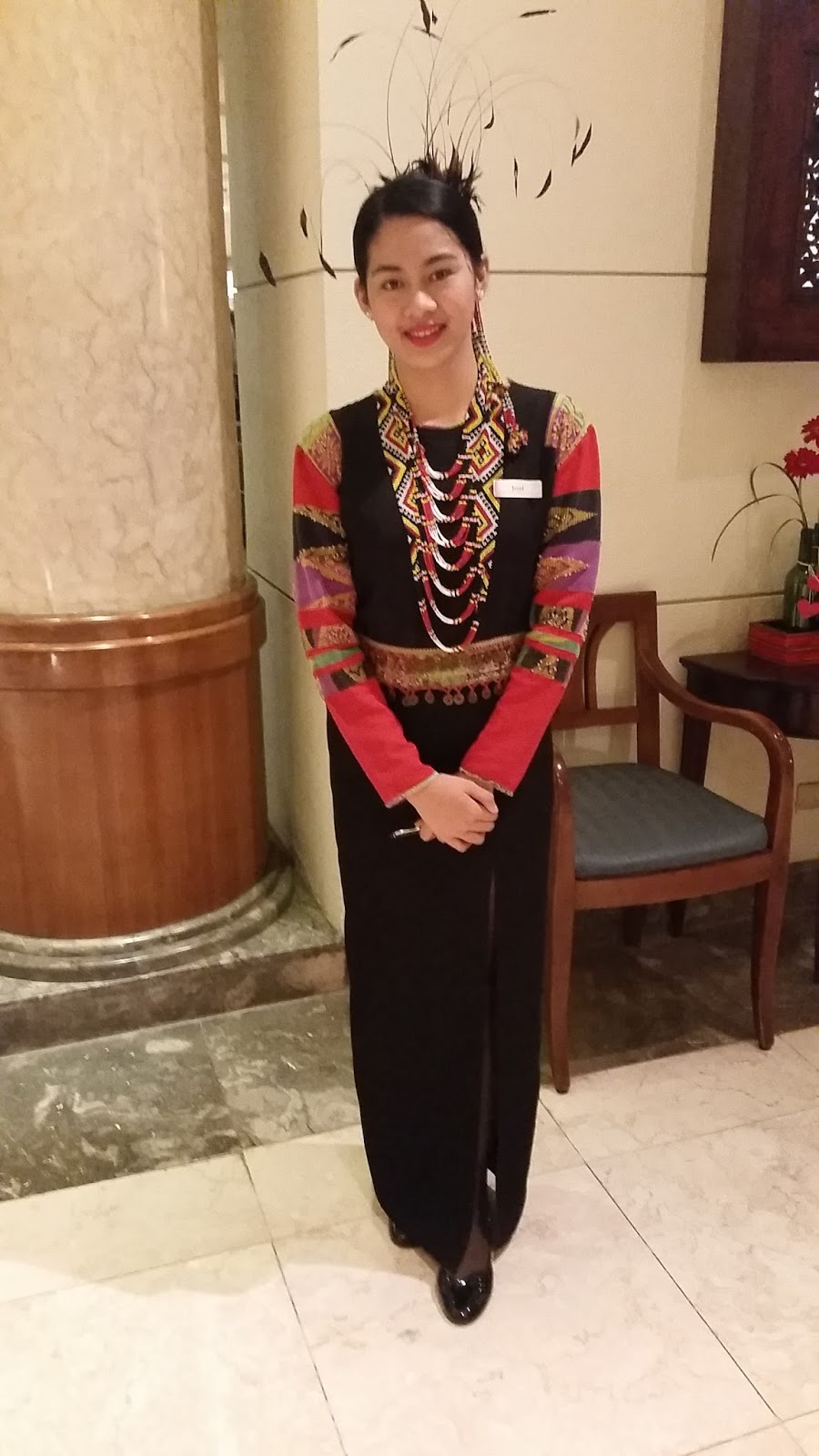
 Here is one of the beautiful women's tradition clothes in Davao for Manobo tribe call Tinalak clothes.